‘Highly inaccurate’: Sheikh Hasina rejects UN report on 2024 Bangladesh protests
The report, titled "Human Rights Violations and Abuses related to the Protests of July and August 2024 in Bangladesh," was published on February 12, 2025.
When Muhammad Yunus assumed charge of Bangladesh’s interim government in August 2024, the moment carried a symbolic weight.




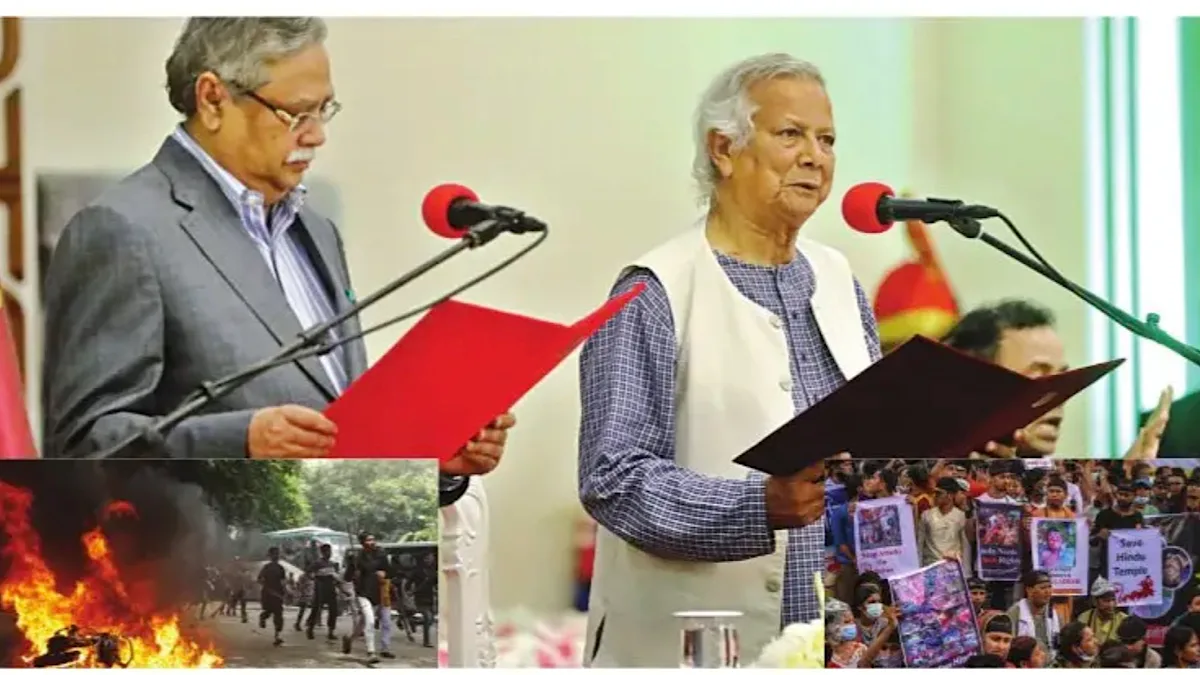
Photo:SNS
When Muhammad Yunus assumed charge of Bangladesh’s interim government in August 2024, the moment carried a symbolic weight. A Nobel laureate stepping in after mass unrest was meant to reassure investors, calm the streets and restore faith in institutions that he alleged had crumbled under Sheikh Hasina’s tenure. Yunus promised his people technocratic governance, political neutrality, and overall stability; he promised the reset of order in Bangladesh after years of political polarisation.
Eighteen months later, those promises lie in ruins. From a slowing economy to the collapse of law and order, from the breakdown of the garment export backbone to a sharp rise in communal violence, Bangladesh under the Yunus regime has entered a phase of systemic instability. The deterioration is not confined to one sector or one crisis. It is across the board – be it economic, social and institutional, and the cumulative effect is pushing the country into a zone of chronic fragility. This is not merely a story of poor performance. It is a story of state drift, where non-performance has created space for radical forces, criminal networks, and sectarian intolerance to flourish.
Advertisement
The most immediate signal of decline is economic. Bangladesh’s GDP growth fell to 3.7 per cent in FY2025, down from 4.2 per cent the previous year, a sharp deceleration for an economy that once was marching on a consistent 6-7 per cent growth rate. The IMF has been explicit about the causes of this decline as it pegs it to the political disruptions following the July 2024 unrest, production stoppages, policy uncertainty and weakening investor confidence. Inflation has remained stubbornly high, eroding purchasing power and driving urban discontent. Foreign exchange reserves currently remain under pressure, forcing the government into a humiliating dependence on IMF disbursements just to meet external obligations.
Advertisement
What was sold domestically as “stabilisation” by the Yunus administration has in reality been survival finance. Bangladesh is now operating under an expanded IMF rescue package exceeding $5.3 billion, including ECF, EFF and RSF facilities. Each tranche comes with painful conditions marred by tax hikes, currency liberalisation and cuts to subsidies that the Yunus government has struggled to implement politically. The result is a complete paralysis as reforms are announced then delayed and diluted, then re-announced, while the cycle of uncertainty persists and the economy drifts. No sector better illustrates Bangladesh’s decline than the Ready-Made Garment (RMG) industry, the country’s economic spine and employer of over 4 million workers.
Since Yunus took over, between 113 and 260 garment factories have shut down, depending on the time window used by industry bodies and labour monitors. Job losses range from 96,000 to more than 220,000. Export orders have fallen and margins have collapsed. The small and medium manufacturers are disappearing from the economic ladder. The causes are both structural and political. Bangladesh blames it on weak global demand, but its problems go deeper as the rising production costs, energy shortages, labour unrest, and above all, policy drift has stalled its economic growth engine. As factories shut, entire districts have slipped into economic distress.
For many households, the garment sector was the last barrier between stability and poverty. Its erosion is now feeding social volatility and crime. If economic decline is the first warning, lawlessness is the confirmation. Police records and national crime data show a sharp rise in criminal activity in 2025 compared to 2024. Robbery cases jumped over 40 per cent. Snatching surged by more than a third. Murders increased. Total registered criminal cases crossed 181,000, up significantly from the previous year. This is not just about numbers. It reflects a deeper breakdown in state authority.
Local communities increasingly rely on informal networks for security and the criminal syndicates operate with growing impunity inside Bangladesh. Political uncertainty combined with complete political hegemony has weakened the policing morale and command structures. The interim government’s inability to restore confidence in the rule of law has allowed fear to replace order, a classic marker of state decay. Perhaps the most dangerous transformation has been social. Between August 2024 and June 2025, civil society groups documented over 2,400 hate crimes targeting religious minorities, Hindus, Buddhists, and Christians. These included killings, sexual assaults, rapes, temple desecration, arson, and mass intimidation. This spike did not occur in a vacuum.
Political paralysis has created space for radical religious actors to reassert themselves on the streets of Bangladesh with near impunity. The Yunus government’s response has been hesitant, reactive and at times silent. Its failure to decisively protect minorities has sent a dangerous signal to the radicalized organizations that now read the signal as intolerance now carries limited or no consequences. For a country built on pluralism and linguistic nationalism, this represents a profound ideological rupture. Bangladesh is not merely unstable; it is slipping toward radicalisation by design. The tragedy of the Yunus regime is not malevolence but miscalculation.
The assumption that technocracy alone could stabilise a deeply political crisis has proven false. Yunus entered office with moral authority but without a political machine, without electoral legitimacy and without control over entrenched bureaucracies. In trying to remain above politics, his government became irrelevant to it. In trying to be neutral, it became ineffective. As performance declined, accountability vanished. As institutions weakened, intolerance grew. As the economy slowed, crime accelerated. Each failure compounded the next. Bangladesh today is paying the price of governance without authority. The country is now at the edge of permanent instability.
The question now is not whether the Yunus government has failed its promises. The real question is whether Bangladesh can arrest the slide before instability becomes structural, before economic fragility hardens into social fragmentation, and before religious radicalism fills the vacuum left by a retreating state. What began as an interim experiment in moral governance has turned into a cautionary tale that good intentions cannot substitute for power, legitimacy and performance. Bangladesh’s crisis is no longer transitional. It is systemic and unless the trajectory changes soon, the country risks entering a decade defined not by growth and resilience, but by drift, division and decline.
(The writer is an independent journalist and columnist)
Advertisement